
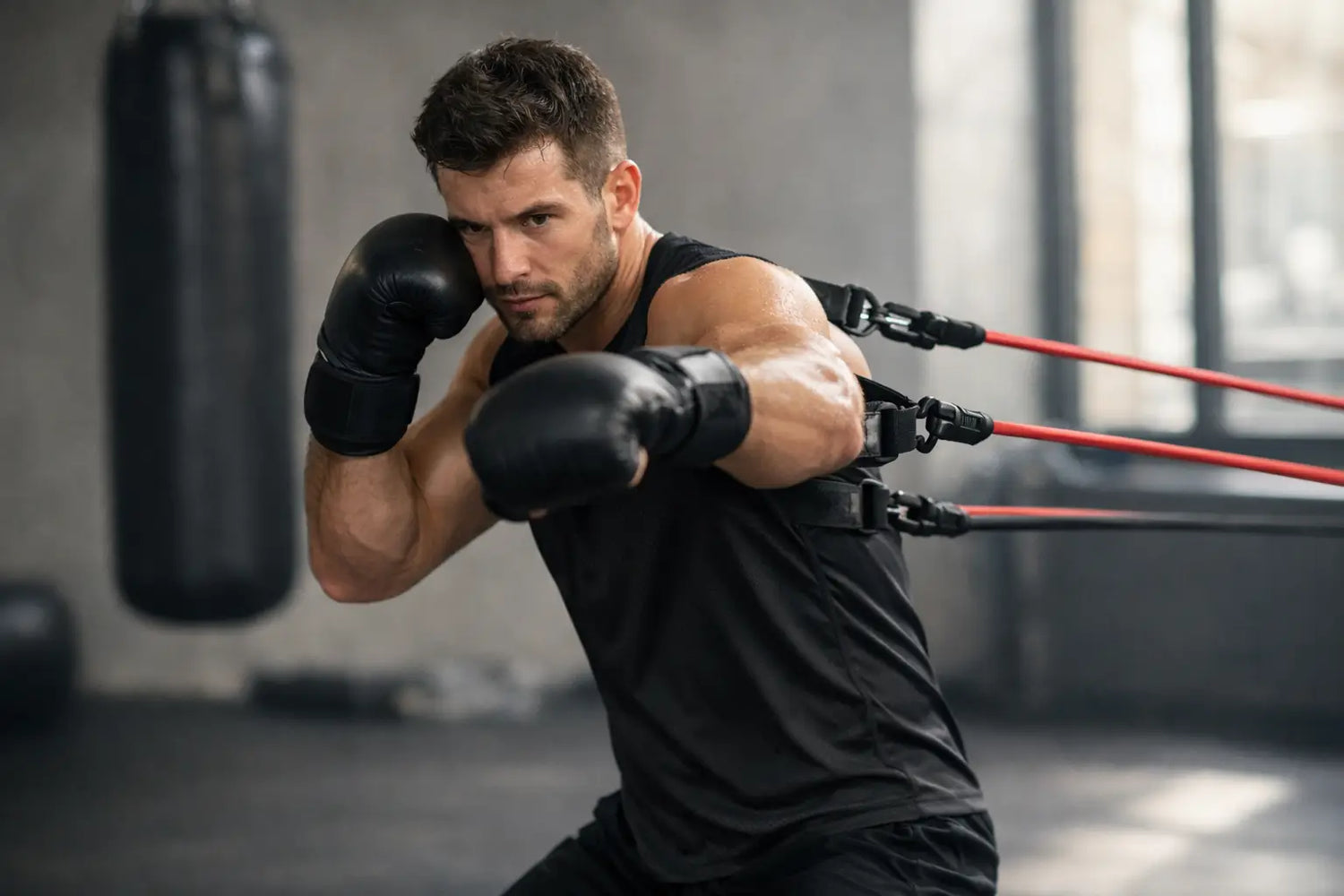
The rounds that expose your weaknesses are usually the quiet ones. No crowd, no bag noise, no coach calling combinations. Just you, your stance, your breathing, and every habit you can’t hide. That’s why shadow boxing with resistance bands has become such a serious tool for fighters and performance-driven athletes. It adds tension where technique usually gets lazy, forcing your body to stay honest through every punch, slip, pivot, and reset.
Used the right way, resistance changes shadow boxing from a light warm-up into a real performance session. You feel your shoulders working to keep the guard high. You feel your hips and core earning every straight shot. You feel your feet responsible for balance instead of just going along for the ride. The result is simple - more intent in every rep and better carryover when it’s time to move fast without the bands.
Why shadow boxing with resistance bands works
Regular shadow boxing is valuable because it sharpens rhythm, coordination, and technique without impact. Add resistance, and the drill starts demanding more from the full system. Not just your arms, but your back, trunk, legs, and posture.
That matters in boxing because punches don’t start at the fist. They start from the floor, transfer through the legs and hips, stabilize through the core, and finish through the shoulder and hand. If your resistance setup only challenges the hands, you can still miss the bigger picture. The best training tension follows the movement pattern in a way that makes your whole body work as one unit.
That’s where athletes separate generic band work from sport-specific band work. Random resistance can make you tired. Purpose-built resistance can make you sharper. There’s a difference.
What resistance changes in your mechanics
The first thing most athletes notice is guard discipline. When resistance pulls on the upper body, dropping the hands gets expensive. Your shoulders and back have to stay engaged, and that reinforces one of the oldest rules in the sport - keep your hands up.
The second change is punch return. A lot of people can throw a jab or cross with decent speed, but the recovery is sloppy. The hand floats back, the elbow flares, the chin rises, and the stance opens up. Resistance punishes that. If you don’t bring the punch back on line, the movement feels wrong right away.
The third change is lower-body involvement. Good shadow boxing is never just upper-body air punching. When bands are connected through the hands and feet, the legs become active drivers of the movement. That means stronger push-off, cleaner pivots, and better control when changing direction.
This is also why shadow boxing with resistance bands can help posture. When the setup challenges your back, core, and stance at the same time, you’re not just practicing offense. You’re training alignment under fatigue.
How to use shadow boxing with resistance bands correctly
The biggest mistake is treating bands like a strength stunt. More tension is not always better. If the resistance is so heavy that your punches crawl, your shoulders shrug, or your stance falls apart, you’re no longer training boxing mechanics. You’re just surviving tension.
Start with resistance that lets you move sharply. Your jab should still snap. Your cross should still rotate clean. Your defense should still look like defense, not a fight against the equipment. The goal is to challenge the pattern without destroying it.
Round structure matters too. Short, focused rounds usually beat long, sloppy ones. Two or three minutes with a clear intent works better than winging punches until your form fades. One round might emphasize a stiff jab and fast return. Another might focus on straight punches and lateral movement. Another might be all defense, level changes, and counters.
Breathe like you mean it. Resistance has a way of making athletes hold tension in the neck and shoulders. That kills speed. Stay relaxed where you can and explosive where you need to be. Sharp exhale on the punch, quick reset, then back to work.
Best training goals for shadow boxing with resistance bands
This method is especially effective when you want more from solo training. If you’re building conditioning, resistance raises the demand without forcing impact on your joints. If you’re cleaning up mechanics, the tension gives immediate feedback. If you want sport-specific endurance, the repeated demand on the shoulders, core, and legs gets there fast.
It also fits athletes who don’t have much space or time. You can get a serious boxing session without a bag, a partner, or a full gym setup. For busy fighters and hybrid athletes, that matters.
Still, it’s not a replacement for everything. You still need unresisted speed work, bag work, mitt work, sparring, and technical coaching if you want a complete game. Bands are a weapon in the system, not the whole system.
Shadow boxing with resistance bands for speed and stamina
There’s a common question here: does resistance make you slower? It depends on how you use it.
If you overload the movement or use bad mechanics, yes, it can teach slow punches. But controlled resistance, used in short rounds and followed by free-speed work, can improve how fast and efficiently you move. The bands force you to apply intent on every shot, then your body feels lighter when the resistance comes off.
That contrast is powerful. One or two resisted rounds, then one clean round without bands, can sharpen hand speed and rhythm immediately. You feel the snap. You feel the feet react faster. You feel the shoulders loosen while still staying active.
For stamina, the payoff is obvious. Keeping the hands high under tension, punching with control, and moving your feet continuously creates a fight-specific conditioning effect. Not treadmill conditioning. Not random circuit fatigue. Work that actually looks and feels closer to the demands of striking.
Common mistakes that kill the benefit
The first mistake is chasing exhaustion instead of precision. Getting smoked is easy. Getting better takes control. If every round turns into ugly flailing, your technique is paying the price.
The second mistake is forgetting defense. A lot of athletes throw more punches once the bands go on, but they stop slipping, rolling, framing, and resetting the guard. That’s backward. Resistance should sharpen defensive responsibility, not erase it.
The third mistake is using equipment that doesn’t respect actual boxing movement. Generic bands can create awkward pull angles that feel unnatural for striking. That doesn’t mean all resistance is bad. It means the design matters. If the setup connects your body in a way that supports authentic movement, you can train harder without teaching bad habits.
That’s why specialized systems stand apart. Boxer Bands was built around real boxing mechanics, not repurposed fitness trends. For serious athletes, that difference shows up in the quality of the movement.
Who should use it
If you box, kickbox, train MMA striking, coach fighters, or just want conditioning that has a real athletic purpose, this style of training makes sense. It’s especially useful for athletes who want more from solo rounds and care about carryover, not just calories burned.
Beginners can use it, but they need restraint. Learn stance, balance, hand return, and basic punch paths before turning every session into resisted work. Intermediate and advanced athletes usually get the most out of it because they can feel where resistance improves timing and where it starts to distort it.
Coaches can also use it well in short blocks. It fits skill sessions, conditioning finishers, and movement prep. The key is intention. Every round should have a job.
How to make it part of your routine
You don’t need to build your whole week around it. Two to four sessions a week is enough for most athletes, depending on the rest of your training. Use it before bag work to wake up posture and mechanics, after technical work for conditioning, or as a standalone session when time is tight.
Keep the rounds focused. Mix straight punches with footwork, defense with counters, and pressure movement with angle changes. Then remove the resistance and let the body express the speed you just trained.
That’s the real point of shadow boxing with resistance bands. Not to make movement look harder for the sake of it, but to build a sharper fighter when the tension comes off. Train with intensity, stay disciplined in every rep, and let the resistance expose what needs work. The athletes who improve fastest are usually the ones willing to feel that truth early, then fix it round by round.


Leave a comment
This site is protected by hCaptcha and the hCaptcha Privacy Policy and Terms of Service apply.